This website is managed by Ultima Markets’ international entities, and it’s important to emphasise that they are not subject to regulation by the FCA in the UK. Therefore, you must understand that you will not have the FCA’s protection when investing through this website – for example:
You will not be guaranteed Negative Balance Protection
You will not be protected by FCA’s leverage restrictions
You will not have the right to settle disputes via the Financial Ombudsman Service (FOS)
You will not be protected by Financial Services Compensation Scheme (FSCS)
Any monies deposited will not be afforded the protection required under the FCA Client Assets Sourcebook. The level of protection for your funds will be determined by the regulations of the relevant local regulator.
Note: UK clients are kindly invited to visit https://www.ultima-markets.co.uk/. Ultima Markets UK expects to begin onboarding UK clients in accordance with FCA regulatory requirements in 2026.
If you would like to proceed and visit this website, you acknowledge and confirm the following:
1.The website is owned by Ultima Markets’ international entities and not by Ultima Markets UK Ltd, which is regulated by the FCA.
2.Ultima Markets Limited, or any of the Ultima Markets international entities, are neither based in the UK nor licensed by the FCA.
3.You are accessing the website at your own initiative and have not been solicited by Ultima Markets Limited in any way.
4.Investing through this website does not grant you the protections provided by the FCA.
5.Should you choose to invest through this website or with any of the international Ultima Markets entities, you will be subject to the rules and regulations of the relevant international regulatory authorities, not the FCA.
Ultima Markets wants to make it clear that we are duly licensed and authorised to offer the services and financial derivative products listed on our website. Individuals accessing this website and registering a trading account do so entirely of their own volition and without prior solicitation.
By confirming your decision to proceed with entering the website, you hereby affirm that this decision was solely initiated by you, and no solicitation has been made by any Ultima Markets entity.
Ultima Markets does not have an establishment in Singapore and does not operate from Singapore.
Ultima Markets does not provide products or services to citizens or residents of Singapore, and account applications from Singapore citizens or residents will not be accepted.
If you are a citizen or resident of Singapore, please do not open an account or use Ultima Markets’ products or services.
By selecting “Acknowledge and Continue Browsing”, you confirm that you are accessing this website on your own initiative and that your access is not the result of any direct marketing, targeted advertising, solicitation, or promotional activity by Ultima Markets.
Nothing on this website constitutes an offer, solicitation, or promotion of products or services in any jurisdiction where such activity is prohibited. You are responsible for ensuring that your access to and use of this website complies with applicable local laws and regulations.
Learn how stop loss hunting works, why stops can trigger before a reversal, and how spreads, order types and position sizing affect overall trading risk.
Your stop triggers, price reverses, and the trade you planned suddenly moves in your original direction. It is tempting to blame stop loss hunting. However, a brief price move followed by a recovery can occur during ordinary market volatility, without proving that anyone targeted your order.
Understanding the difference between order mechanics and deliberate manipulation helps you analyse unexpected exits more carefully. The starting point is knowing what happens when stops activate.
What Is Stop Loss Hunting?
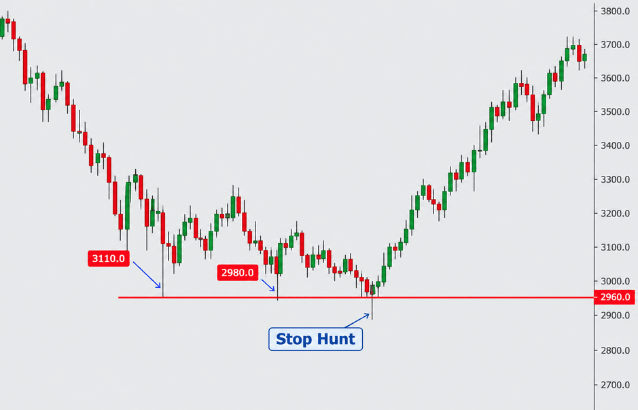
Stop loss hunting refers to deliberate or suspected attempts to move prices towards levels where stop-loss orders are concentrated. It is also called “stop hunting” or “running the stops”. Crucially, the label can imply intent that a chart alone cannot establish.
A conventional stop-market order becomes a market order when its trigger is reached. Stops protecting long positions generate selling, while those protecting short positions generate buying. The trigger price is not a guaranteed execution price.
These orders can cluster near obvious levels. Historical currency-market research published by the New York Fed documented sell stops below round numbers and buy stops above them. Such concentrations can reinforce an existing price move.
How Clustered Stops Can Move the Market
Consider a hypothetical GBP/USD trade. Price is trading above support at 1.2700, and several traders have placed stops protecting long positions at 1.2695.
When price reaches that trigger, their orders generate selling. If available buyers cannot absorb the volume at nearby prices, the market can move lower and activate further stops.
What happens next depends on the balance of orders. Buyers might absorb the selling and push price back above 1.2700. Alternatively, selling could continue and the breakout could develop into a larger decline.
This second outcome matters. New York Fed research found evidence that stop-loss orders can contribute to self-reinforcing price cascades. A move through clustered stops is therefore not automatically a reversal signal.
An untriggered stop should not be confused with a visible limit order available for execution. CME, for example, explains that its futures stop orders do not immediately enter the order book when accepted.
Why Can a Stop Trigger Without the Chart Reaching It?
Sometimes the explanation is the difference between the bid and ask prices.
For standard forex positions in MetaTrader 5, a long position’s stop is checked against the bid, or sell quote. A short position’s stop is checked against the ask, or buy quote. Charts for over-the-counter instruments are based on bid prices.
Suppose you hold a short EUR/USD position with a stop at 1.1050. The bid is 1.1048, but the ask rises to 1.1051 as the spread widens.
Under an ask-based trigger rule, your stop can activate even though the bid-only chart remains below 1.1050. This hypothetical example illustrates why the visible candle may not tell the whole story.
Before attributing an exit to stop loss hunting, check the relevant quote and execution rules. Exchange-traded instruments can use different triggers.
Is Stop Loss Hunting Real or Market Manipulation?
Deliberate manipulation involving stops has been documented. In a 2018 enforcement action, the CFTC found that a Deutsche Bank trader manipulated or attempted to manipulate precious-metals futures prices to trigger customers’ stop-loss orders for proprietary benefit.
The FX Global Code also identifies deliberately moving the market to a client’s stop-loss level as unacceptable practice. However, the Code provides good-practice principles for the wholesale FX market, not a standalone law.
These distinctions matter: documented misconduct does not establish that every stop-out is manipulation. A price chart shows movement, not the intentions behind every order.
How to Manage the Risk of Premature Stop-Outs
Plan the Exit Level and Position Size Together
Choose a stop where your trade idea would no longer be valid, rather than selecting a random distance. Allow for normal price movement, then calculate a position size that fits your planned monetary risk.
For a hypothetical EUR/USD trade, assume one pip equals 0.0001 and your planned price-loss budget is US$100:
Position size
Distance to stop
Planned price loss
€50,000
20 pips
US$100
€25,000
40 pips
US$100
The calculations are 50,000 × 0.0020 = US$100 and 25,000 × 0.0040 = US$100. Doubling the distance requires halving the position to maintain the same planned price loss.
These figures assume execution at the stop and exclude separate charges. Slippage can increase the actual loss. A wider stop is not automatically safer.
Understand Volatility and Order Types
Review recent price ranges, scheduled announcements and the current spread before entering. Avoid widening a stop impulsively simply because price is approaching it.
Where available, a stop-limit order restricts the acceptable execution price, but it may remain unfilled. It is not a guaranteed way to avoid losses. FINRA highlights this trade-off in its guidance on stock orders.
Review the Execution Evidence
After an unexpected exit, record the instrument, trade direction, stop level, timestamp and execution price. Check the bid and ask quotes, not just the candle.
Ask the broker to explain the trigger and fill using its execution policy. Comparing charts is more useful when the instrument, price type and timestamps match, particularly because chart prices and execution prices can differ.
Conclusion
Understanding stop loss hunting is less about predicting a suspicious wick and more about understanding your orders. Treat an unexpected exit as something to investigate, not automatic proof that the market targeted you.
Build the trade around a logical exit level, an appropriate position size and clearly understood execution rules. The aim is not to avoid every losing trade, but to keep risk deliberate and manageable.
FAQ
Can Brokers See My Stop Loss?
A broker handling a server-side stop receives its instructions. That does not mean every market participant can see every trader’s stop.
Can Stop Hunting Be Avoided Completely?
No stop-placement method guarantees this. Focus on logical exit levels, suitable position sizes and understanding the applicable trigger rules.
Does a Liquidity Sweep Guarantee a Reversal?
No. Price can continue after stops activate. A move through clustered stops does not establish a reliable reversal signal.
Is a Stop-Limit Order Safer Than a Stop Loss?
It controls the acceptable execution price but may not execute. The trade-off is price control versus the risk of remaining in the position.
Share Now
Disclaimer:This content is provided for informational purposes only and does not constitute, and should not be construed as, financial, investment, or other professional advice. No statement or opinion contained herein should be considered a recommendation by Ultima Markets or the author regarding any specific investment product, strategy, or transaction. Readers are advised not to rely solely on this material when making investment decisions and should seek independent advice where appropriate.
Thank you for visiting the Ultima Markets website. Please note that this website is intended for individuals residing in jurisdictions where access is permitted by law. Ultima and its affiliated entities do not operate in your home jurisdiction.
By clicking ‘Acknowledge’, you confirm that you are entering this website solely on your own initiative and not as a result of any specific marketing outreach. You wish to obtain information from this website based on reverse solicitation principles, in accordance with the applicable laws of your home jurisdiction.